A Couple Travels Art Exchanged Items and Stories Turtle
Texans You Should Know is a serial highlighting overlooked figures and events from Texas history.
When Ila Loetscher walked onto the set of the Late Show With David Letterman in 1985, the studio audience erupted in laughter. A petite woman in her eighties, her face wrinkled from decades spent in the lord's day, she held a live sea turtle that was dressed in a red dress and a tiny chocolate-brown wig. Its flippers stuck direct out, unmoving, as if it were a puppet. Loetscher offered the reptile to Letterman.
"No, I don't want it!" he said. As the laughter died downwardly, Loetscher took a seat and began to tell Letterman about the turtle. "This is an Atlantic light-green, and its name is Gerry." The rest of the segment went like a circus human activity crossed with a PBS special: Loetscher kissed the turtle. She had Gerry do tricks, such as stroking her face up with its flippers. She shared facts about sea turtles and spoke about their endangered status. And, in a move that delighted the audition, she removed Gerry's dress to reveal a pair of frilly pink bloomers.
But Gerry was not simply an exotic pet, and Loetscher non just a quirky sideshow human action. After condign one of the first female person pilots in her abode state of Iowa, she after moved to South Padre Island and in 1977 founded Body of water Turtle Inc., a nonprofit that has rescued and released thousands of turtles. Known as the "Turtle Lady," Loetscher was nigh famous for her educational presentations involving costumed sea turtles—a kitschy shtick that hasn't aged well, only that nevertheless helped to brainwash thousands of people about endangered species. Her advocacy played a role in prompting stronger protections for bounding main turtles, including the Kemp'south ridley, which made a rare comeback from the brink of extinction. Co-ordinate to Ocean Turtle Inc. lath member Pat Burchfield, "She did more all the turtle biologists and researchers put together to popularize sea turtles and the plight of sea turtles, and make that a worldwide phenomenon."
Born October 30, 1904, Ila Fox exhibited a flair for showmanship early on on. She grew up in Iowa, where she would put on plays with her siblings in the family's befouled. She studied drama and speech in college, and in her mid-twenties she enrolled in flight school, where she agreed to promote her school to the media in exchange for extra flight hours. "On Sundays and holidays it was my duty to beautify myself in the most sexy flight togs of that era (black riding boots, tight pants, white jacket, and a white helmet tucked under the arm)," she later wrote. "With the honest urge to succeed and a small serving of 'ham' thrown in, I presently learned to walk straight towards the newsman belongings the biggest photographic camera." In 1929, Loetscher became the first Iowa woman to get a pilot's license. She joined the Ninety-Nines, a women's flying guild founded past her friend Amelia Earhart.
After marrying her college sweetheart, David Loetscher, Ila quit flying and the couple moved to New Bailiwick of jersey. Merely the children she hoped for never came, and in 1955, David died of cancer. Loetscher's parents had retired to Texas, and she decided to join them. Later a stint in Pharr, she moved to Padre Island, where she befriended Dearl Adams, a citizen conservationist who wanted to establish a second nesting surface area for the endangered Kemp'south ridley. The species had only one rookery, in Mexico, and its numbers were plummeting as locals collected the eggs to sell as nutrient (a do that was legal at the fourth dimension). From 1963 to 1967, Adams, his wife, and several friends gathered eggs from Mexico and planted them in the South Padre sand. Loetscher joined Adams on an egg-gathering trip in 1966. When 54 ridleys hatched that twelvemonth, he gave her iii, hoping she could raise them and learn more about the species.
"Those iii hatchlings . . . were basically the genesis of the Ocean Turtle Lady of South Padre Island," says Burchfield, who likewise heads the Gladys Porter Zoo in Brownsville. People who heard about Loetscher started bringing her injured sea turtles, and soon her beach house was filled with turtles splashing around in kiddie pools (she later installed tanks in the backyard). Loetscher obtained federal and land permits allowing her to care for the turtles, and eventually she released most of them into the wild. "They are such lovable and ambrosial creatures," she told the Associated Printing in 1977. "Yous just have to take them as members of the family."
Recuperating turtles that were also large for the kiddie pools lived in submerged wooden enclosures in the bay. Curious locals and visitors began to stop by this spot, and Loetscher started giving "Meet the Turtles" talks there in the sixties. She publicized the turtles whatsoever fashion she could, property almanac birthday parties for them, bringing them to schools, and talking most them on local radio programs. Merely as she had one time advertised her flying schoolhouse, she threw a serving of ham into her Turtle Lady persona. On multiple occasions, she even dressed turtles in pajamas and tucked them into miniature beds for the news cameras. (She had showtime recognized the entertainment value of costumed animals in New Jersey, where she once tickled community-theater audiences by bringing a costumed chicken onstage.) Loetscher also enlisted the help of a neighbor, who sewed an entire article of clothing drove for the reptiles. "She was ever in the papers, and they had so much fun with her, 'cause she was so outgoing," says her niece, Mary Ann Tous. "She was just a very dynamic person . . . If you met her, it was just—she engulfed you."
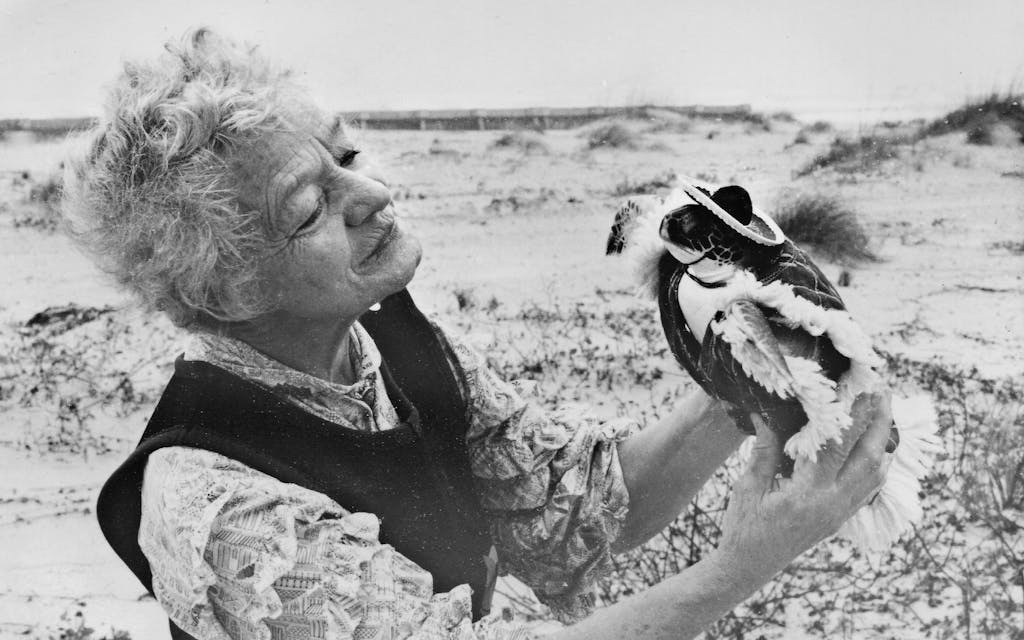
The sombrero-wearing, suited, bewigged turtles helped rocket Loetscher to national fame. In improver to her Letterman appearance, she took ii turtles on the The Tonight Bear witness Starring Johnny Carson in 1982. A Japanese TV evidence sent a coiffure to South Padre to profile her. Fan letters poured in from all over the land and from as far away equally France. Tous remembers visits when she would wake up tardily at dark and see the calorie-free shining on her aunt'due south desk. "I'd say . . . 'What are you doing?' She says, 'I'm answering the messages.' I says, 'But it'due south and so late, dear.' She says, 'Well, if they had the fourth dimension to write, I have the time to answer.' "
Some observers disliked the turtle costumes. "I don't think it acquired whatsoever harm, but certainly a biologist would've looked askance at that," says Burchfield. Merely, he says, "The ridley was almost gone entirely, and if they didn't do something quickly, it would disappear forever. And despite all our best efforts as scientists, we weren't making much headway, upward until we started to go the general population behind that kind of a ground movement. . . . As soon as the public starts getting behind something, then the legislators and the people that tin can outcome policy start to pay attention."
Indeed, Loetscher's efforts helped inspire stronger protections for the turtles. While only a few female ridleys returned to nest at Dearl Adams'due south rookery, federal officials took notice of his and Loetscher's work, and in 1978, United mexican states and the U.S. initiated a multiagency project to restart the nesting surface area. The endeavour succeeded. The number of Kemp'due south ridley nests in Texas rose exponentially until hitting 195 in 2008; it has gone upward and down since, just maintains an annual boilerplate of 201.
Even after Loetscher died in 2000 at the historic period of 95, the changes kept coming. Oklahoma senator James Inhofe, who had once worked with her, became a key supporter of the 2004 Marine Turtle Conservation Act, which has provided millions of dollars for body of water turtle conservation in other countries. In 2013, Texas made the Kemp'due south ridley the land sea turtle. And Sea Turtle Inc., which grew out of Loetscher'southward abode clinic in 1977, has released virtually 50,000 hatchlings in the past ten years. Information technology has too treated thousands of injured and impaired turtles, including a record number of cold-stunned turtles during the Feb 2021 freeze, and climatic change will likely contribute to more than such events. The system besides continues Loetscher's educational piece of work—687,000 visitors have dropped past in the past four years to bout the facility and see presentations, albeit without whatsoever costumed critters. Gerry, now 220 pounds, is still a star attraction.
In a society that sanctions cuddling puppies but not reptiles, Ila Loetscher was not afraid to wear her love for turtles on her sleeve. According to a 1977 article, she owned ceramic turtles, turtle-shaped jewelry, and turtle-themed ashtrays, paintings, and pot holders. She also believed her turtles could recognize her vox, obey commands, and fifty-fifty feel emotions. "I've learned a lot well-nigh love from my turtles," Loetscher told a reporter in 1984. "I've learned human beings aren't holding the whole hugger-mugger."
Once, a twelve-twelvemonth-erstwhile boy was looking for a book about baseball when he came beyond Loetscher and her turtles at a library in Rockport. "I'thousand thinking, 'This is just actually foreign. This is worth seeing what the heck this is,' " recalls Merritt Clifton. "I didn't expect to be watching for very long, because I figured out information technology was a talk most sea turtles, and I didn't know beans about sea turtles. I didn't care beans about bounding main turtles." Loetscher made such an impression on him that he stayed for the whole presentation. He later grew up to become an environmental journalist, and he now runs a site near animal news. "The whole concept of ecology—as everything relating to everything else—she was the beginning one that I heard information technology from," says Clifton, now 68. "That talk was where I first heard about an outlook that would influence me for the residual of my life."
For Loetscher, a widow with no children of her own, her turtles and the people at her presentations formed a sort of family unit. "When the schoolhouse buses would come [to Sea Turtle Inc.], full of children, she would wait outside the door with a little turtle in her mitt," says Tous. "And the turtle would be, y'all know, waving its little flipper. . . . The children would unload and walk by her, and they'd wait at her with so much love."
Clifton wasn't the just kid who was inspired by a presentation from the Turtle Lady. "Some of them grew up to be biologists who are now working with the turtles," says Donna Shaver, who knew Loetscher and leads turtle conservation at Padre Isle National Seashore. Others, she says, "became wealthy developers and they gave contributions that helped starting time rehab hospitals, or exercise other things for sea turtles. You lot need all of society to exist supportive in various ways."
"There's that maxim that you can't conserve what you don't love, and you lot tin't love what you don't encounter," Shaver adds. "She gave [people] the opportunity to meet these animals."
Source: https://www.texasmonthly.com/travel/south-padre-turtle-lady-kemps-ridley/
0 Response to "A Couple Travels Art Exchanged Items and Stories Turtle"
Post a Comment