Reading and Note Taking Study Guide American Government
The main reason for taking notes in a lecture is to exist able to utilise them later on, for example in exams or in your academic writing. Information technology is therefore important not only for you to understand how to note the chief points accurately, but likewise how to note them with a articulate organization, which the relationship between the ideas conspicuously shown. This page describes two unlike means to organise your notes, namely linear notes and pattern notes. It also gives data on a very common method of note-taking, the Cornell Method.
Linear notes
Linear notes are the simplest and therefore the about common style of notes, both for reading and listening. The word linear is the adjective of the give-and-take line, which indicates that these notes are written down the page, 1 line after the other. This type of notes is sometimes called outline notes as they are similar in format to the outline of an essay. 2 common features of this style of notes are the employ of:
- numbering or lettering;
- indentation.
The use of numbering/lettering and indentation is of import to assistance distinguish the chief points from the small-scale ones. The employ of indentation too helps to make the information more visual, which is useful for visual learners (although of class linear notes are not as visual equally pattern notes, described in more detail below). An example of linear notes, for information on this page, is given below.
- go downwards the page
- use letters/numbers
- use indenting
- more visual
- several types
a) Spidergram
b) Flowchart
c) Table
d) Tree diagram
From the above, it tin hands be seen that there are ii primary topics (linear notes and pattern notes). These are indicated both by the use of numbering (1, two) and indenting (all the other information is moved beyond the page, to the right of these ideas). Both of the main ideas have several supporting points. As these are not in any kind of sequence or guild, there is no need to utilize lettering or numbering, and in this case a dash is used to point each indicate. For the 2d main indicate (design notes), four types are given, indicated past a combination of lettering (a, b, c, d) and indenting.
When using lettering, it is possible to use majuscule or small letters, or large or small-scale roman numerals, as shown in the table beneath.
| Numbers | 1, 2, 3, four, 5, ... |
| Large roman numerals | I, Ii, III, IV, 5, VI, Vii, Viii, Ix, Ten, ... |
| Pocket-sized roman numerals | i, ii, 3, 4, v, vi, vii, viii, 9, x, ... |
| Uppercase messages | A, B, C, D, Due east, ... |
| Small messages | a, b, c, d, e, ... |
These can be used in any combination which you prefer, though for clarity it is important to make certain each level uses a different system. The notes higher up, using a unlike combination of numbers/letters, could expect like this:
- go downward the page
- use letters/numbers
- utilize indenting
- more than visual
- several types
i. Spidergram
ii. Flowchart
iii. Table
iv. Tree diagram
The main advantage of linear notes is that they are usually very articulate, especially when there is a articulate construction to the lecture (or reading text, for reading and notation-taking). The master disadvantage is that they are not equally interesting or visual as design notes, which ways the data may be less memorable.
Design notes
Blueprint notes are notes which are non linear and therefore have some distinctive design. There are iv main types considered here, which are spidergram, table, flowchart and tree diagram.
Spidergram
A spidergram, also known as a heed map, is a diagram in which ideas are linked to each other past lines, usually starting from the middle and working outwards, making the diagram look a piffling like the web of a spider (spidergram is a combination of the words spiderweb and diagram). Although information technology can exist used at any fourth dimension, it is best when at that place is i central topic with several sub-topics related to information technology. An example of a spidergram, for data on this page, is given below. In this spidergram, the key topic is pattern notes, and there are iv sub-topics, namely the four types of design notes described on this page.
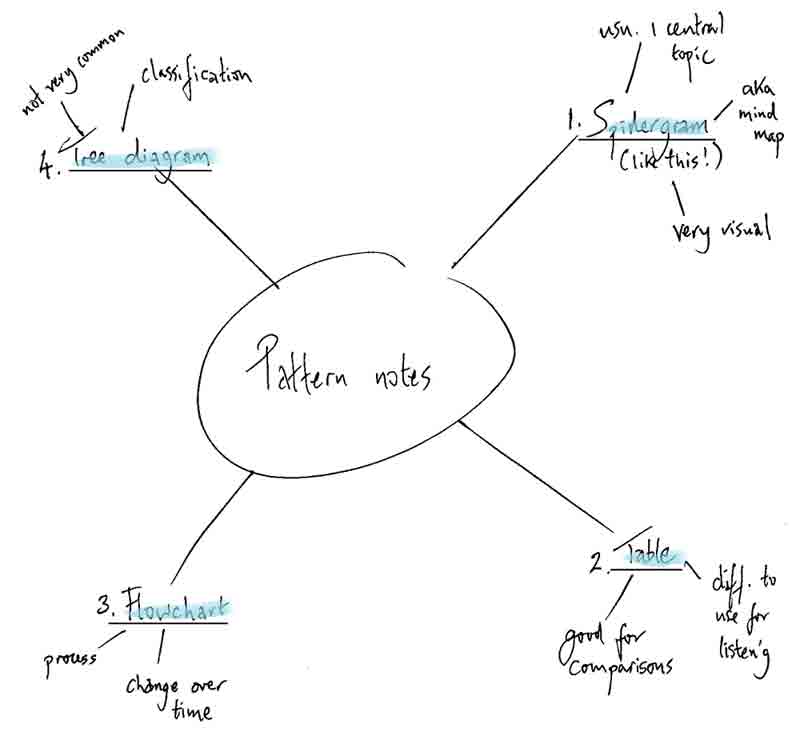
The advantages of this style of notes are that information technology is quick and like shooting fish in a barrel to brand, and it is very visual, which makes it ideal for visual learners. It is as well easy to add together information afterward. It tends to be briefer than linear notes, which could be both an reward and a disadvantage.
Table
Another type of pattern notes is a table. This is most commonly used when ii unlike things are compared, and is therefore usually simply used for function of a lecture (or reading text). It can be difficult to utilize this style of notes when listening, as when you are listening you need to make a very quick determination of which style to use, though it is easier to use when reading and note-taking since you take more than fourth dimension to recall before making notes. If 2 things are being compared, this is definitely an constructive form of notes to utilize, as it makes the similarities and differences very clear. Below is an case of a table, for information on this folio.
| Linear notes | Design notes |
| Connection between ideas very clear Not very visual May be a piddling boring Can be hard to add info later | Connection between ideas quite clear Very visual Commonly quite interesting Usu easy to add info afterward |
Flowchart
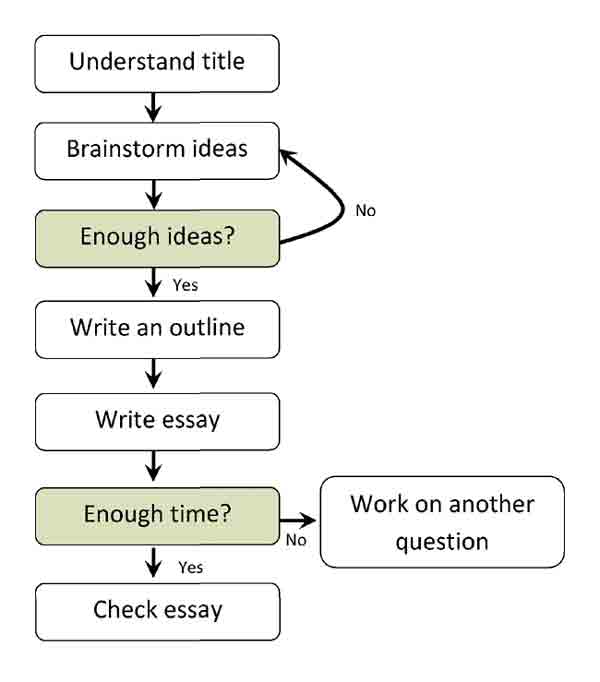
A flowchart is useful if yous want to show a process or a change over time. A flowchart commonly has steps shown in boxes connected past arrows which show the social club. Below is an example of a flowchart, for the process of writing an test essay.
Tree diagram
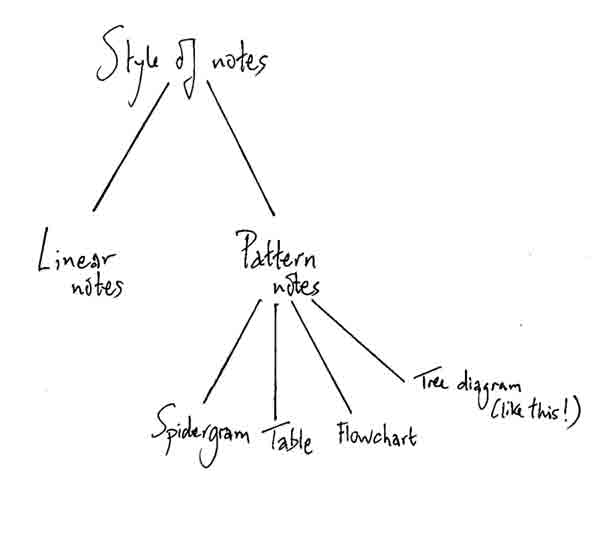
A tree diagram is another form of pattern notes. It is called a tree diagram because, if turned upside-down, it resembles a tree. This type of notes has a specific apply, which is to prove nomenclature. Below is an example of a tree diagram for information on this page. Here it can be seen that notes can exist divided into two types, linear and pattern. Pattern notes can be sub-divided into 4 principal kinds, namely spidergram, table, flowchart and tree diagram.
The Cornell Method
The Cornell Method is a particular method of notation-taking, rather than a carve up style. It was developed in the 1950s by a professor at Cornell University, and is especially common at universities in the USA. For this method, the page is divided into iii areas: notes get on the right side of the page; questions are added on the left; while a summary is added at the terminate. The space on the correct for notes is the largest area. This is a method of note-taking rather than a style since the ii styles described higher up, linear and pattern, can both be used within the Cornell Method when noting the main points. The chief advantages of this method are that information technology is specifically designed for making notes in a lecture, and the questions ensure a more active engagement with the lecture. The main disadvantage is that it tin accept some time to acquire how to take notes using this method.
The page format for Cornell notes is shown below.
Summary
In short, there are two main styles of notes, linear notes and pattern notes, with pattern notes sub-divided into four main kinds, which are spidergram, tabular array, flowchart and tree diagram. Whichever way you employ, yous should still try to make the master points as articulate as possible, and ensure the connections between ideas are also articulate, so that you volition exist able to use your notes afterward. Both styles tin can employ headings, underlining, highlighting and space to assist brand these relationships clear. Although some styles of notes are ameliorate suited to item functions, for case a table when comparison or contrasting, or a flowchart for showing a procedure, which style you choose volition depend on your ability to recognise the all-time type to use, and also your ain personal preference.
Go Gratuitous EBOOK
Like the website? Effort the book. Enter your email to receive a costless sample from EAP Foundation: Bookish Presentations.

Below is a checklist for unlike styles of annotation-taking. Use it to check your understanding of the data on this folio.
Wallace, G.J. (1980) Report Skills in English. Cambridge: Cambridge University Printing pp.52-56.
Source: https://www.eapfoundation.com/listening/notetaking/styles/
0 Response to "Reading and Note Taking Study Guide American Government"
Post a Comment